How Loop works

The mechanics of a
closed loop.

Loop follows a simple GTD arc — capture, clarify, process, route, review. Here's what each part does, and why it's built the way it is.

01 · Capture

The Inbox & Capture box

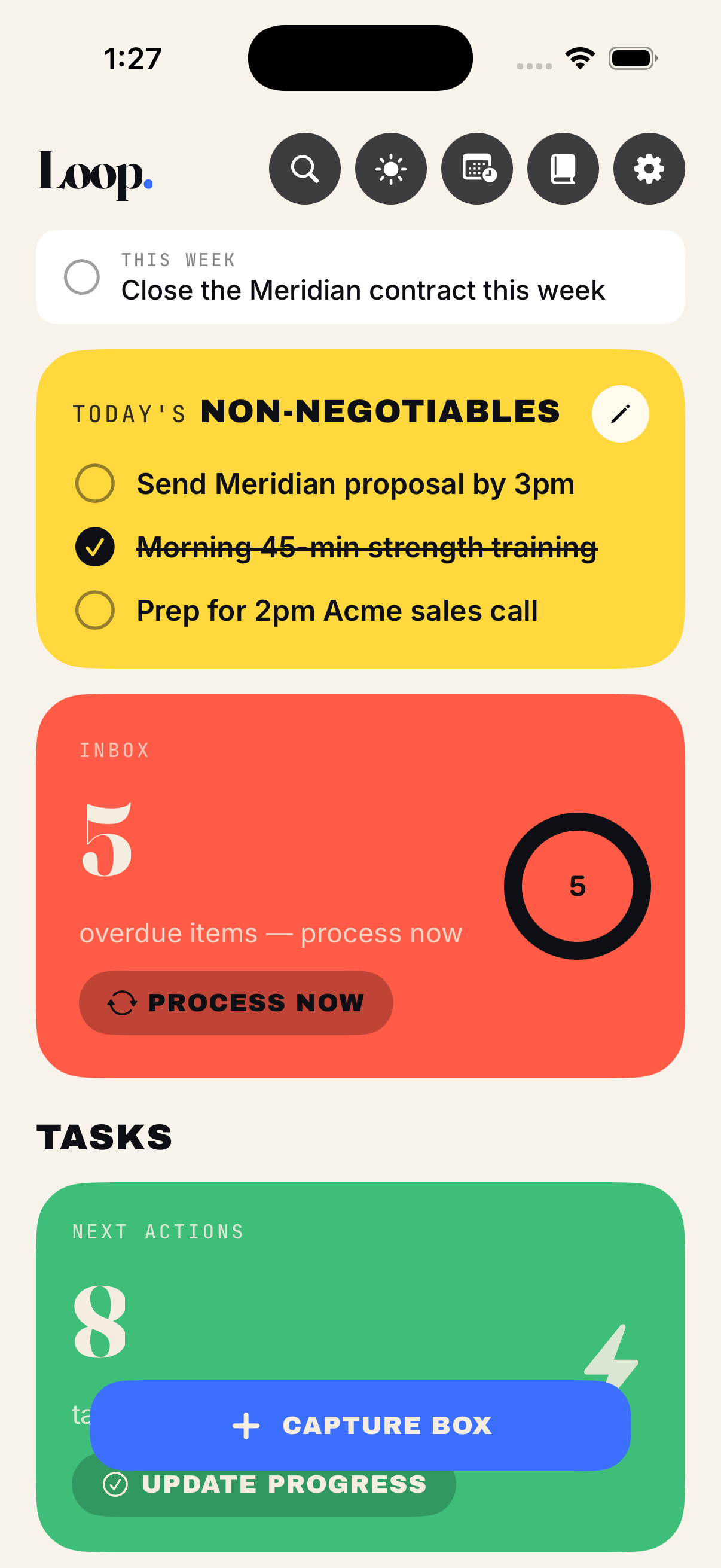
Every trusted system starts in the same place: a single, frictionless spot to offload whatever is on your mind. In Loop that's the Capture box, pinned to the bottom of your Home screen. One tap, type the thought, done — it drops into your Inbox and gets out of your head before it can turn into a nagging loop.

The point isn't to organize in the moment. The point is to capture without deciding. A stray idea, a task, a half-formed worry, a link to read later — it all goes to the same place, so your brain learns it can let go. That trust is the whole foundation. Without it, you keep re-holding everything yourself.

The Inbox is deliberately a holding pen, not a home. Things don't live there — they wait there until you clarify them. Which is exactly what the wizard is for.

And you don't always have to reach for your phone. Loop works with Siri, so you can run it hands-free — say "add three things to Loop" and reel them off while you're driving, walking, or between meetings, and they land in your Inbox ready to process. Siri can also surface what matters on command — today's Non-Negotiables, this week's objective, your current goals — or kick off your daily or weekly review by voice. For a busy operator whose hands are always full, it's the shortest path from a fleeting thought to a system you trust.

Hands-free · Ask Siri
  • "Add 'email the landlord' to Loop."
  • "Add three things to Loop."
  • "What are today's non-negotiables?"
  • "Show my current goals in Loop."
  • "Start my weekly review in Loop."

Your brain is for having ideas, not holding them.

  1. 1 Capture Loop's Home screen with the Capture box pinned at the bottom and the Inbox count waiting to be processed.

    Dump anything into the Inbox.

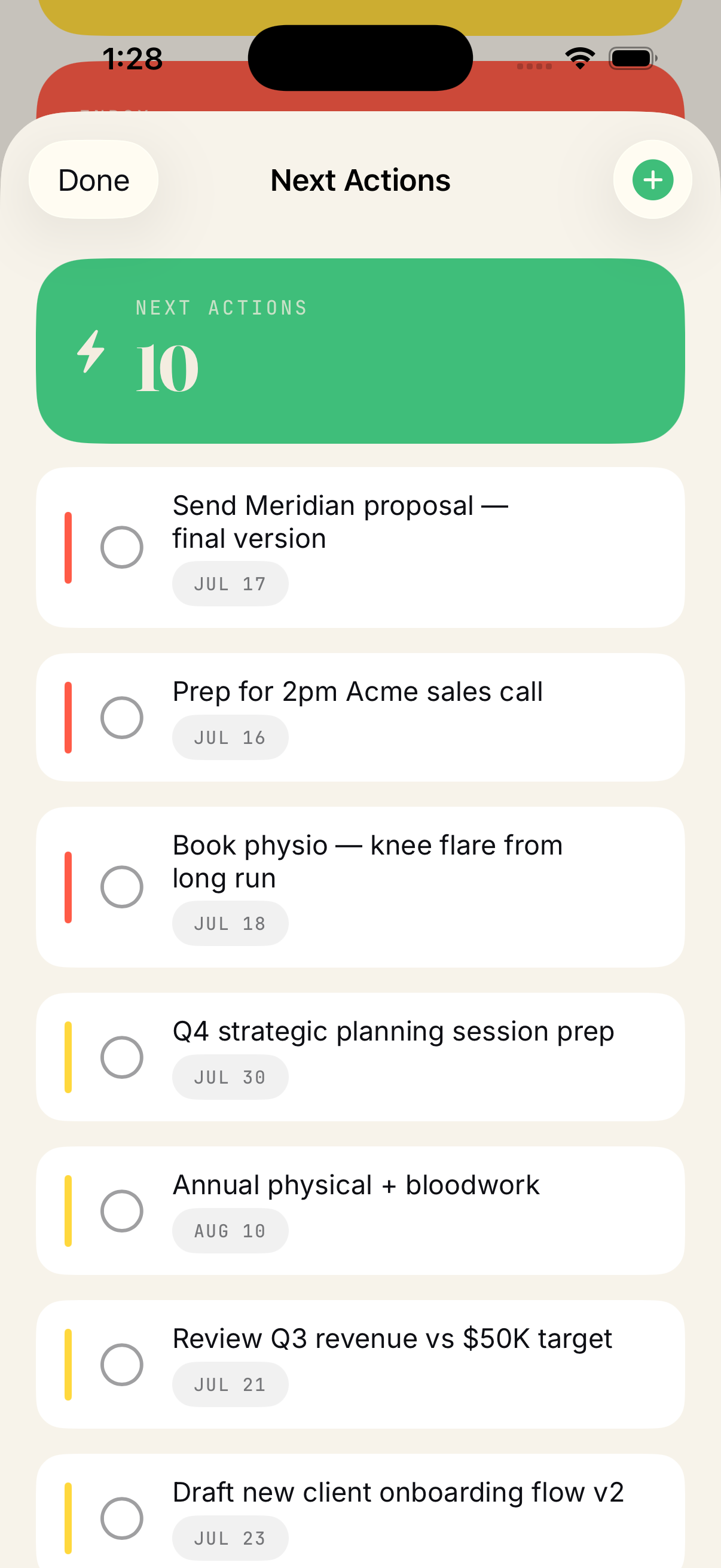
  2. 2 Next Actions Loop's Next Actions list: processed captures turned into clear, dated next steps.

    Once processed, it becomes a clear next step.
02 · Clarify & route

The processing wizard

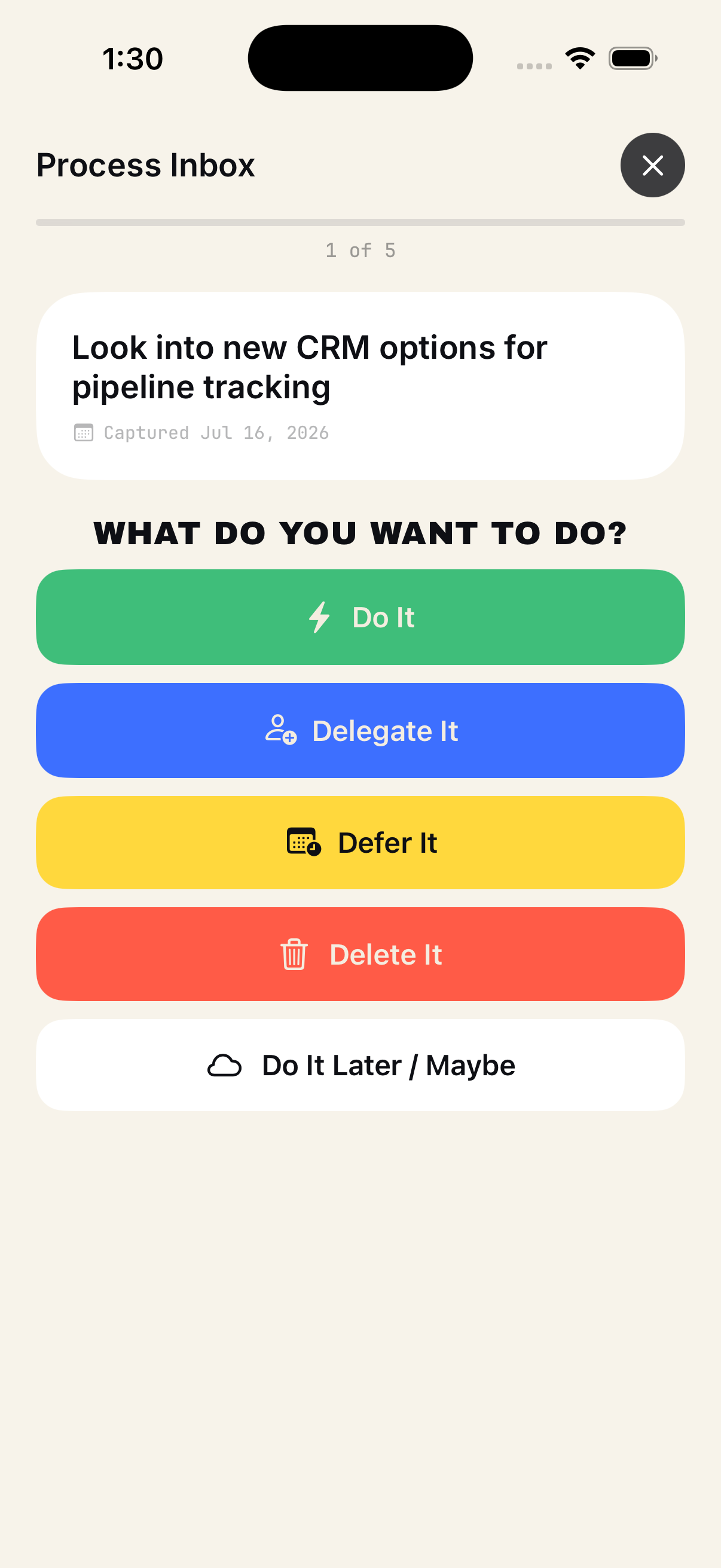
Capturing is easy. Deciding is the hard part — and it's where most task apps abandon you, leaving a graveyard of vague entries you'll never look at again. Loop's processing wizard walks you through the Inbox one item at a time, turning each raw capture into a decision in four quick taps.

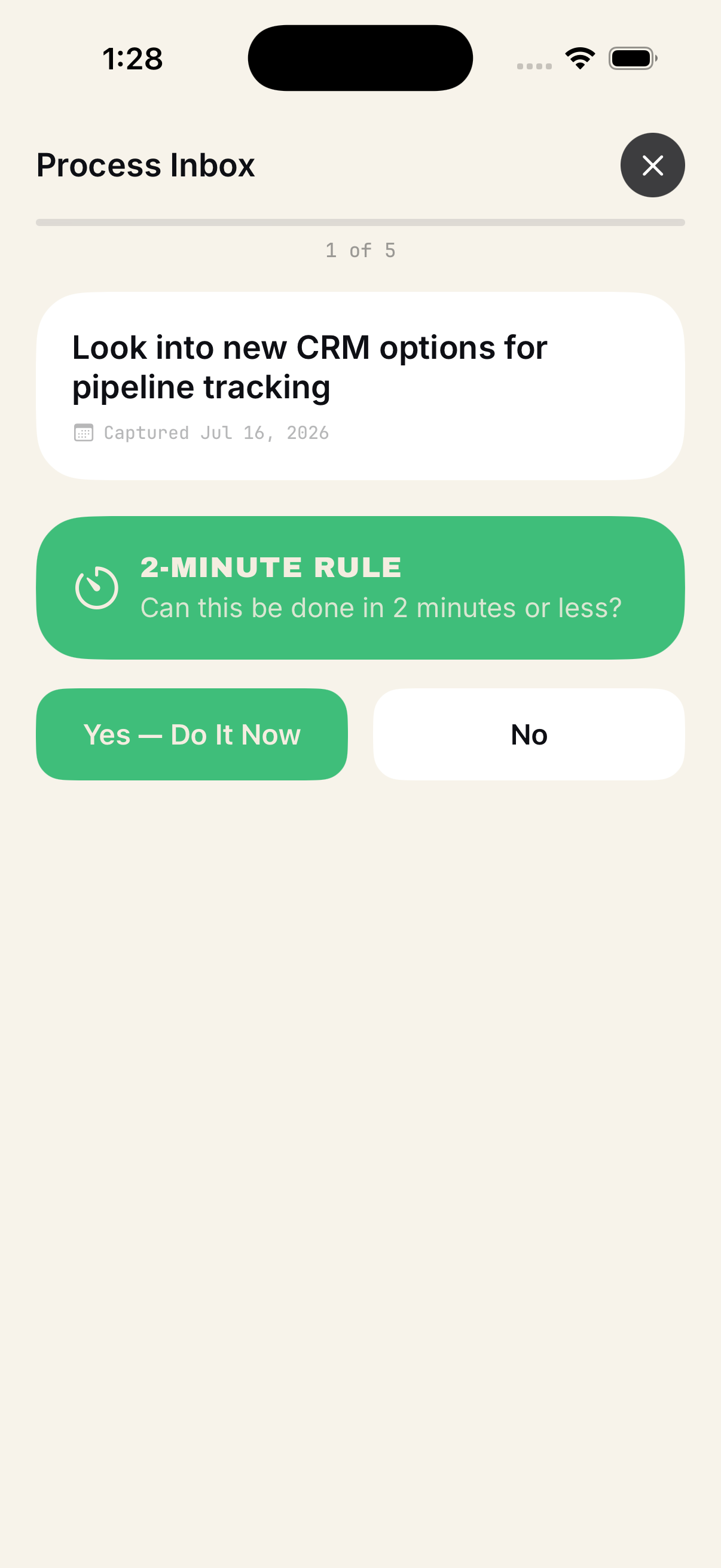
It starts with the 2-minute rule, asks you to clarify the real next action, gauges how important it is, then routes it — do it, delegate it, defer it, or file it as someday-maybe. By the time you reach Inbox Zero, nothing is a question mark anymore.

Clarify once, so you never have to re-decide.

  1. 1 2-minute rule Processing wizard step 1: Can this be done in two minutes or less? Yes — do it now, or No.

    Small enough? Just do it now.

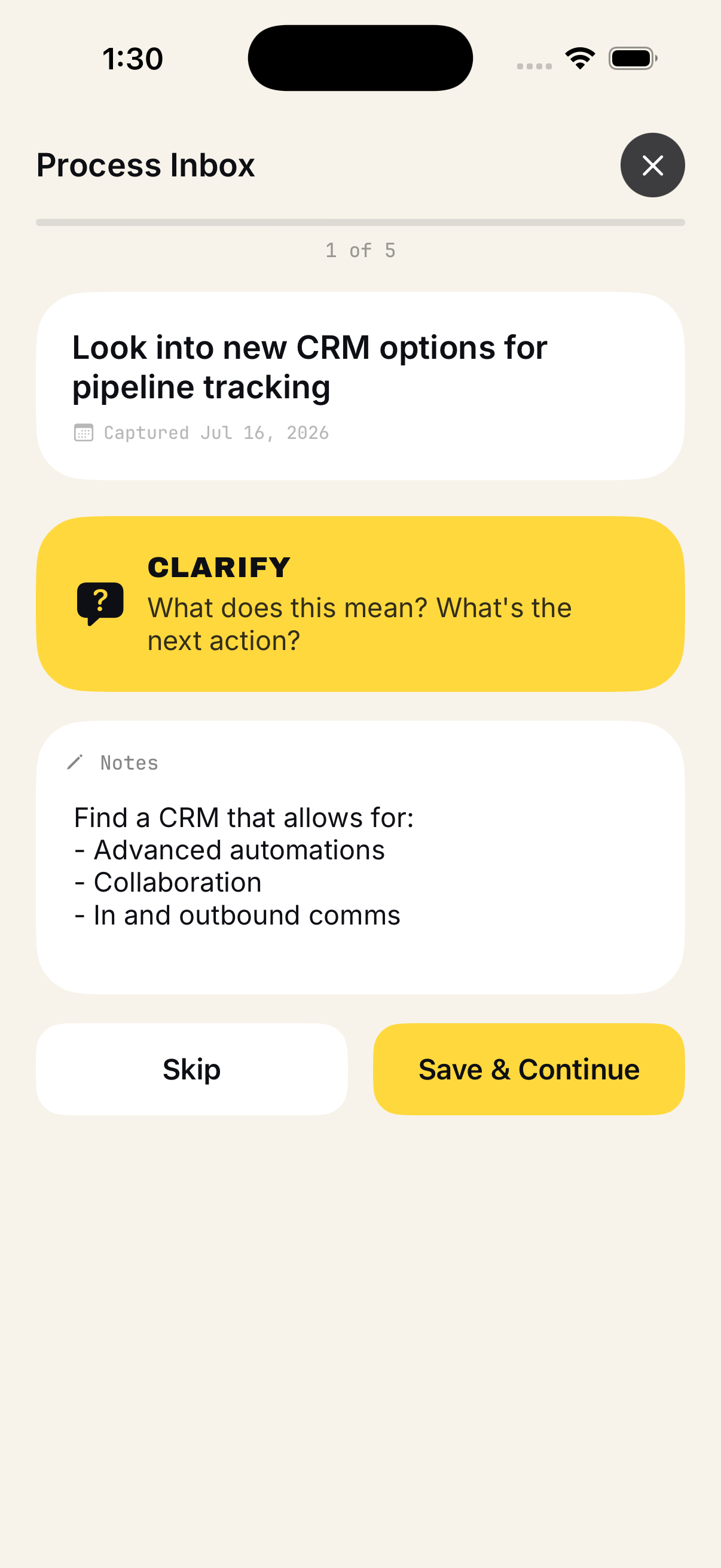
  2. 2 Clarify Processing wizard step 2: Clarify what the item means and what the next action is, with a notes field.

    Name the real next action.

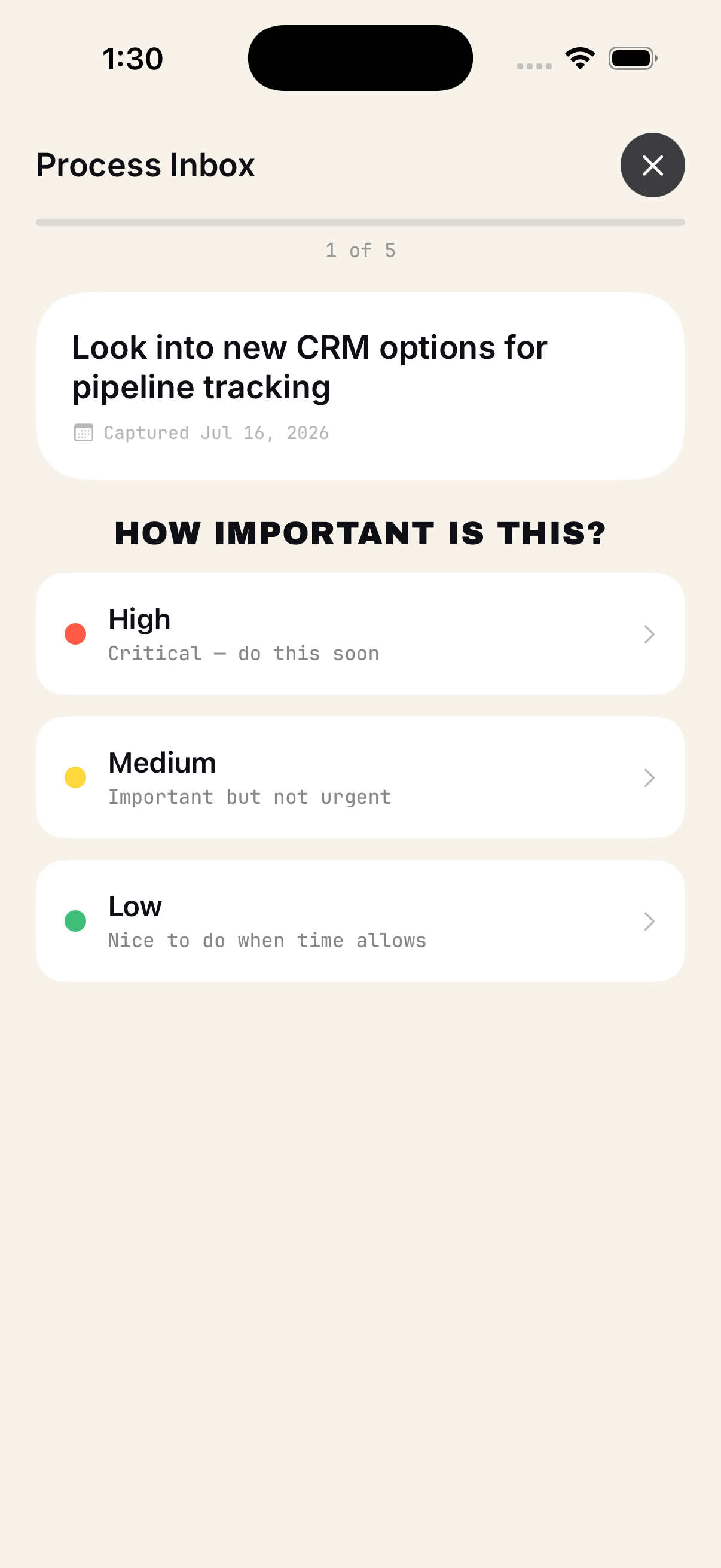
  3. 3 Importance Processing wizard step 3: How important is this? High, Medium, or Low.

    High, medium, or low.

  4. 4 Route Processing wizard step 4: What do you want to do? Do it, Delegate it, Defer it, Delete it, or Do it later / maybe.

    Do, delegate, defer, or file.

03 · Daily plan

Daily Non-Negotiables

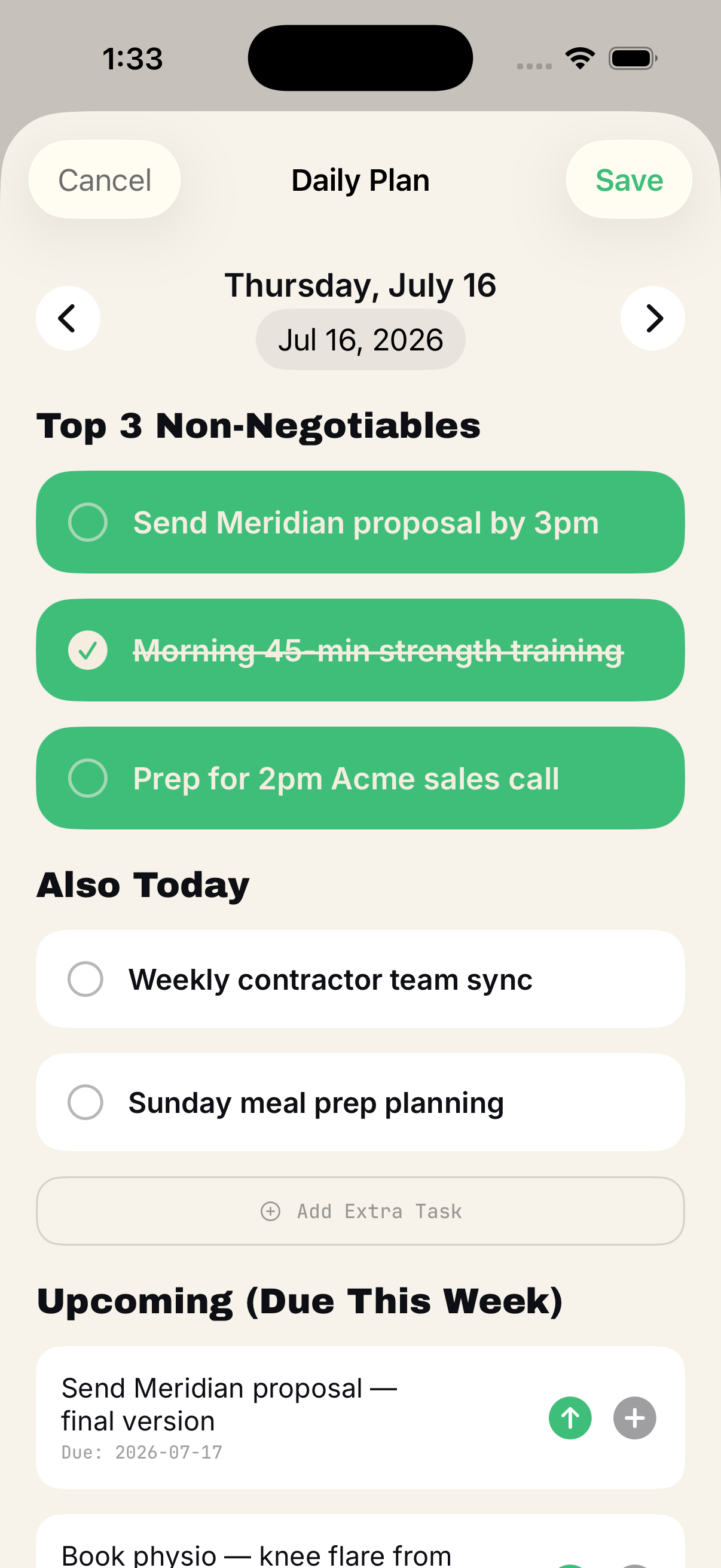
A list of forty tasks isn't a plan — it's a way to feel busy while avoiding the hard call about what actually matters today. Each morning, Loop asks you to pick your Non-Negotiables: a maximum of three things that, if you did nothing else, would make the day a win.

The cap is the feature. Three forces a real choice and protects you from the tyranny of the urgent — the small, loud tasks that crowd out the important, quiet ones. Everything else is still there in your lists, but your day has a spine. When someone asks what you're working on, you have an answer, and when the day gets chaotic, you know exactly what to protect.

Finish your three and the rest of the day is a bonus, not a debt. That's a very different feeling from staring down a list that only ever grows.

Three things. If you do nothing else, do these.

Loop's Daily Plan showing the top three Non-Negotiables, with one completed, plus Also Today and Upcoming.

04 · The weekly ritual

The Weekly Ritual

Planning your week and reviewing it aren't two separate chores in Loop — they're one ritual. Depending on the day you sit down, Loop frames it as planning the week ahead or closing the week that just ended, but it's the same eight-step flow either way. You close out last week and set up next week in a single sitting — no switching between "plan mode" and "review mode."

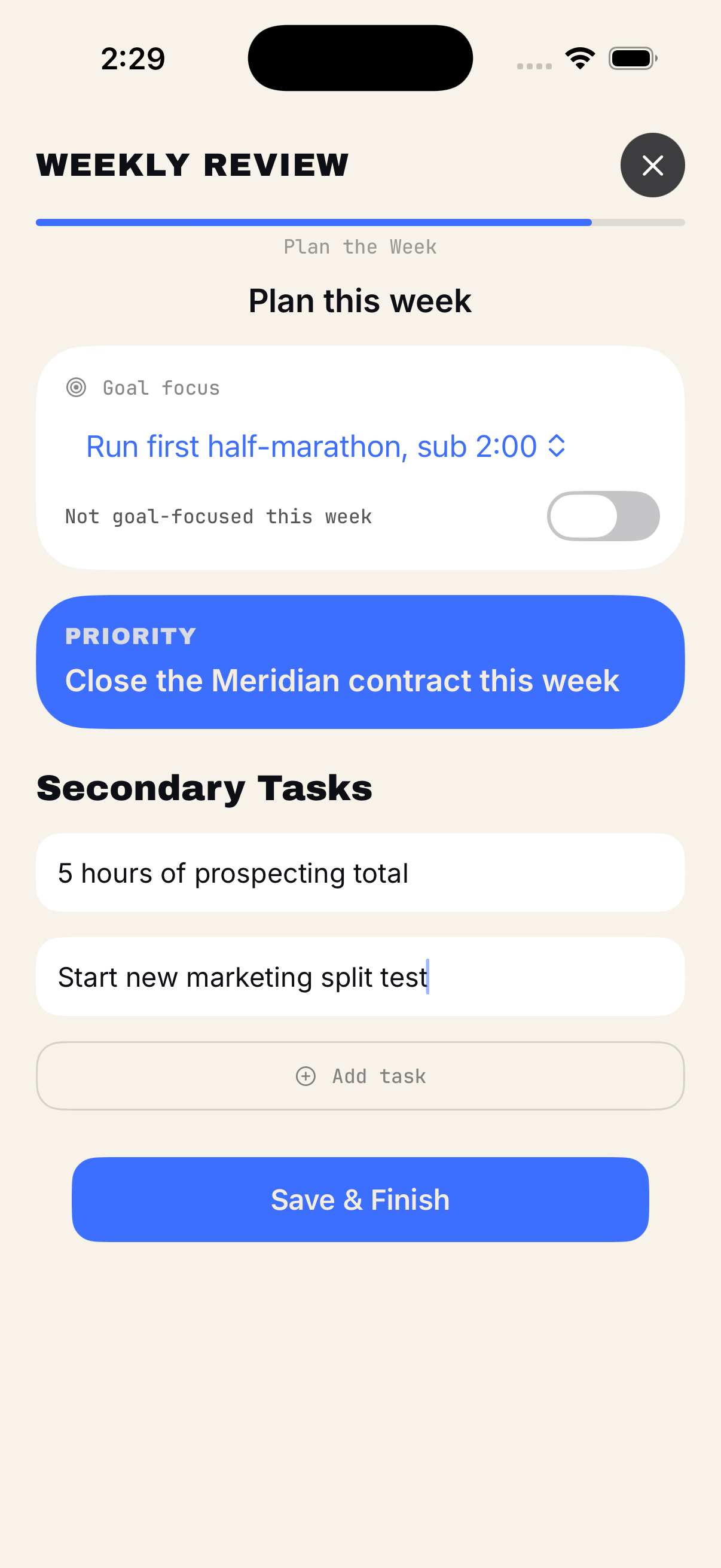
Most apps hand you a blank canvas for weekly review — a template you have to remember to fill out every Friday. Loop's is the opposite: a conversation, not a canvas. Every phase is a screen with two or three big buttons. Grade last week's priorities, empty your inbox, triage your Delegated and Someday items, then set next week's #1 goal. You can't blank-page-freeze on it, and you can't quietly skip it.

Nothing falls through the cracks. Dropped or migrated tasks auto-carry into next week's plan, Delegated items older than seven days flare "stale," and if you miss your scheduled day the home screen keeps a red "close out last week" pill up until you finish. It runs on the same GTD spine as the Daily Ritual — a shorter, three-step version you do each morning — so the whole app feels like one coherent habit.

Weekly review, but you actually finish it.

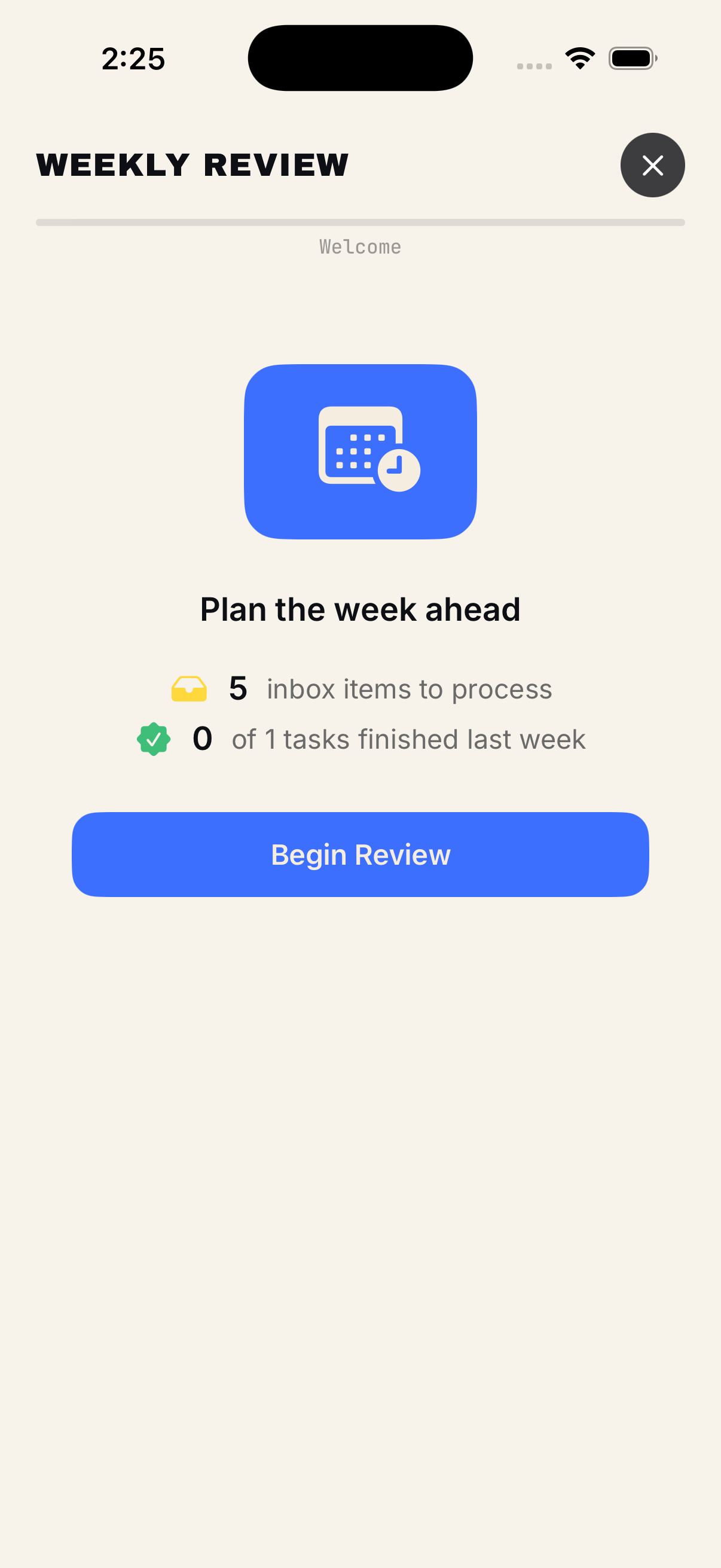
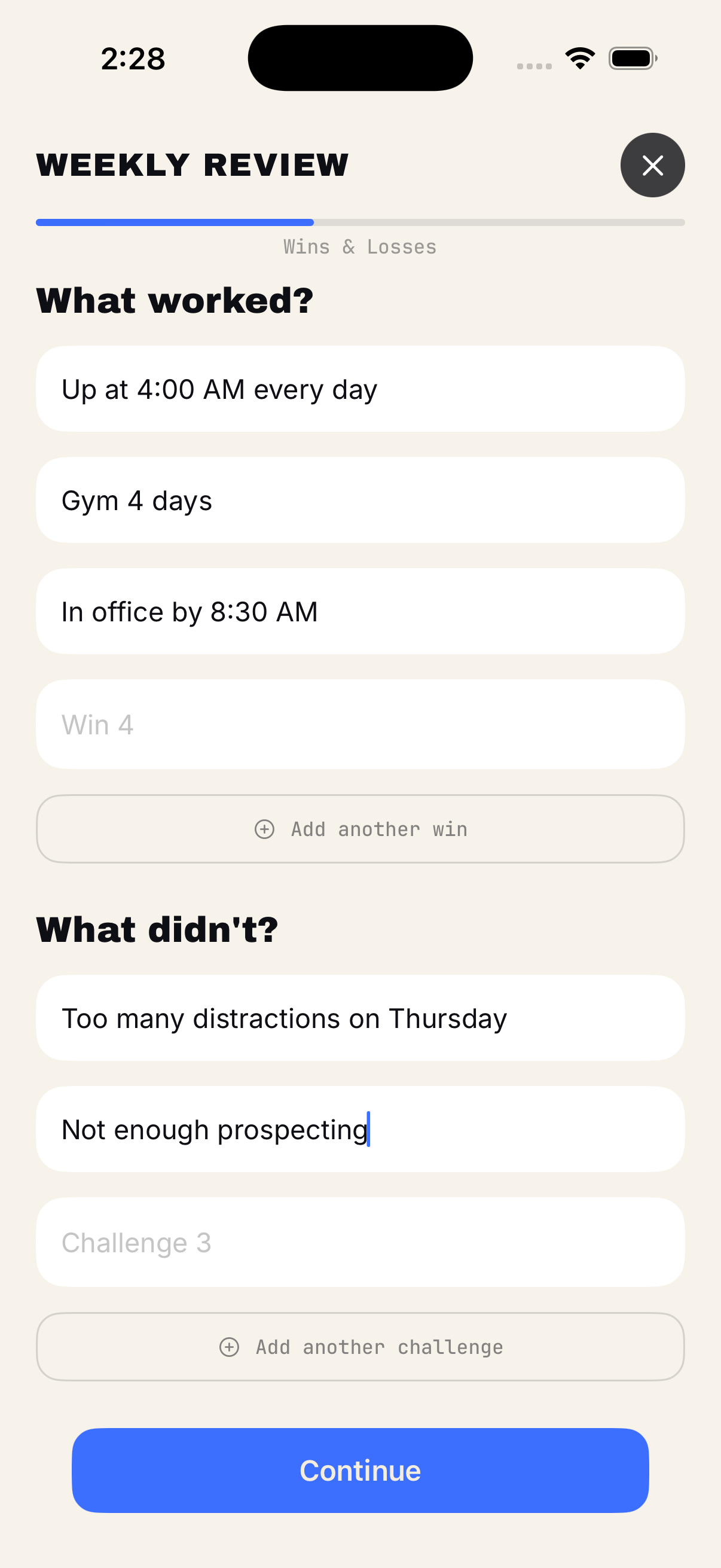
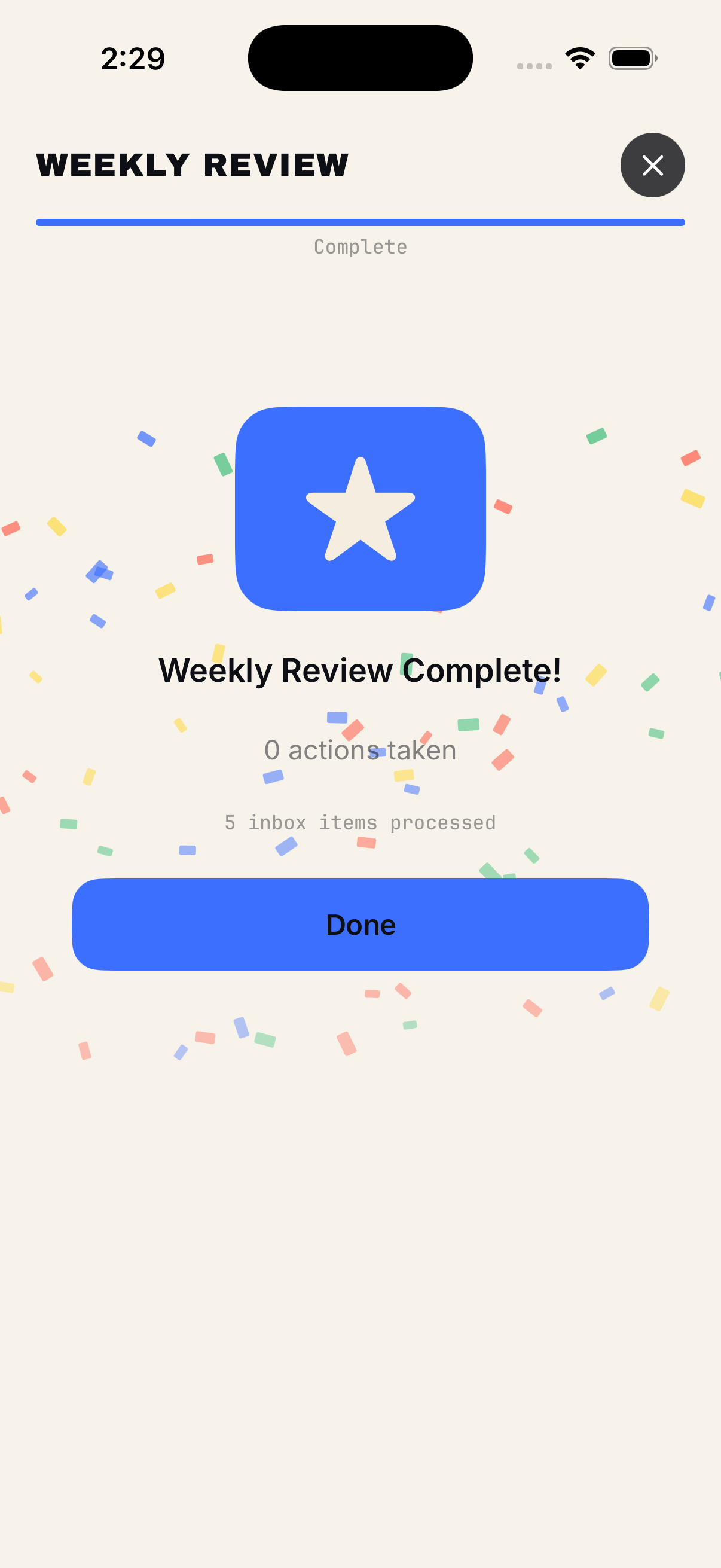
Weekly Ritual, Welcome step: a preview of inbox depth and last week's completion stats, with a Begin button. Weekly Ritual, Wins & Losses step: free-form journaling of what worked and what didn't. Weekly Ritual, Plan the Week step: a goal focus, your #1 priority, and secondary tasks. Weekly Ritual, Complete step: confetti and a tally of everything you touched.

1 / 8 Welcome

  1. WelcomeSee your inbox depth and last week's stats. One tap to begin.
  2. Get ClearInbox-zero — every loose task runs the 2-minute → clarify → route flow.
  3. Last WeekGrade each priority: Done, Migrate, or Drop.
  4. Wins & LossesJournal at least one win and one challenge.
  5. DelegatedTriage everything you're waiting on. Stale after seven days.
  6. Someday / MaybePromote, keep, or drop every parking-lot idea.
  7. Plan the WeekSet your goal focus and #1 priority. Carry-overs pre-filled.
  8. CompleteConfetti, and a tally of everything you touched.

05 · The 3-max rule

Quarterly Goals

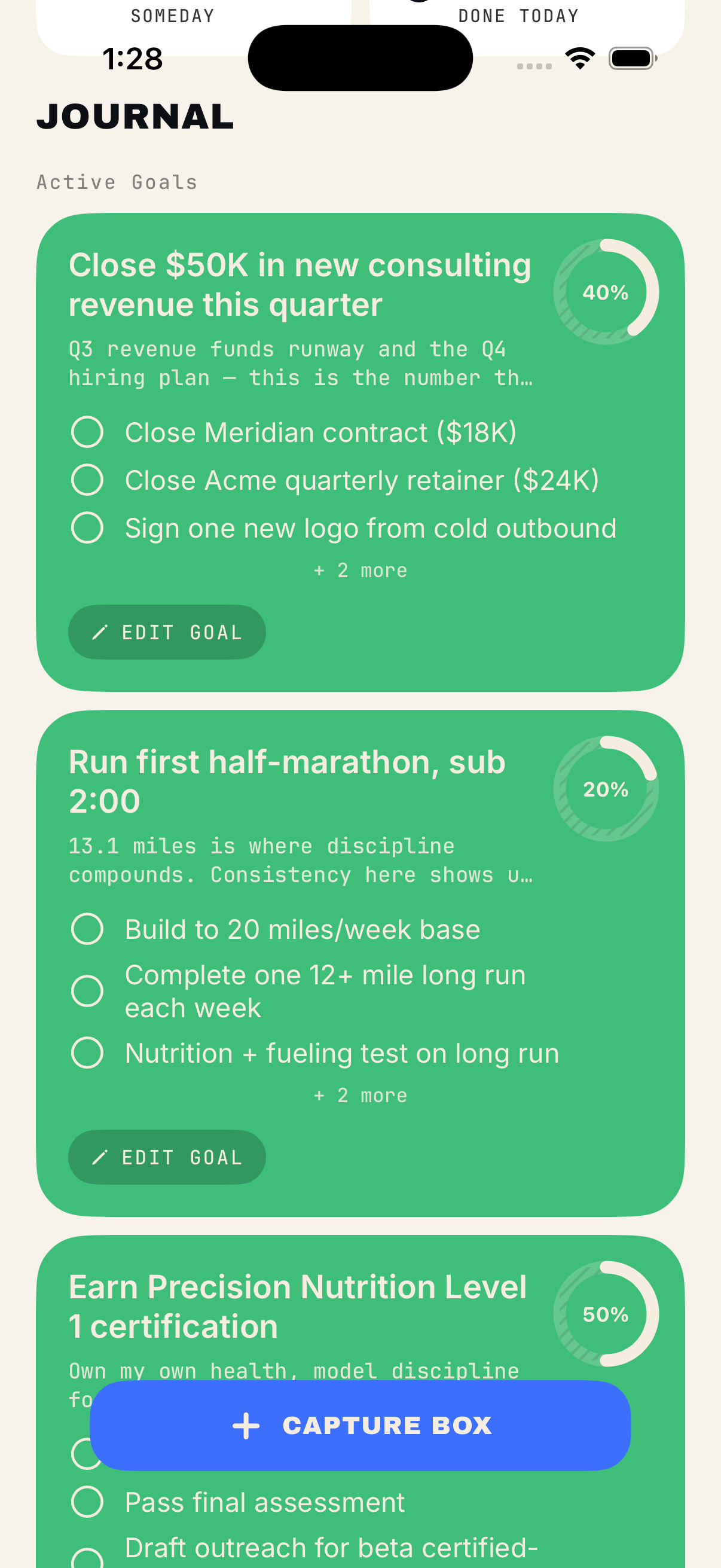
Focus isn't about doing more things well — it's about doing fewer things at all. Loop caps your active Quarterly Goals at three, on purpose. You literally cannot start a fourth until you finish or drop one of the current three. The constraint does the disciplining so you don't have to.

Capping matters because ambition is cheap and attention is not. Five goals means five things half-done and a running sense that you're behind on all of them. Three means each one gets enough of you to actually move. Your quarterly goals tie directly into the Weekly Ritual, so the big ambitions and the daily grind stay connected — every week either moves a goal forward or honestly admits it didn't.

It's a small rule with a large effect: it turns "someday I'd like to" into "this quarter, these three."

Three goals, fully alive, beat ten on life support.

Loop's Active Goals with progress rings for three quarterly goals.

06 · Nothing lives only in your head

Delegated & Deferred

Two kinds of tasks quietly slip through every system: the ones you handed to someone else, and the ones you pushed to later. Loop gives both a dedicated home so neither depends on you remembering.

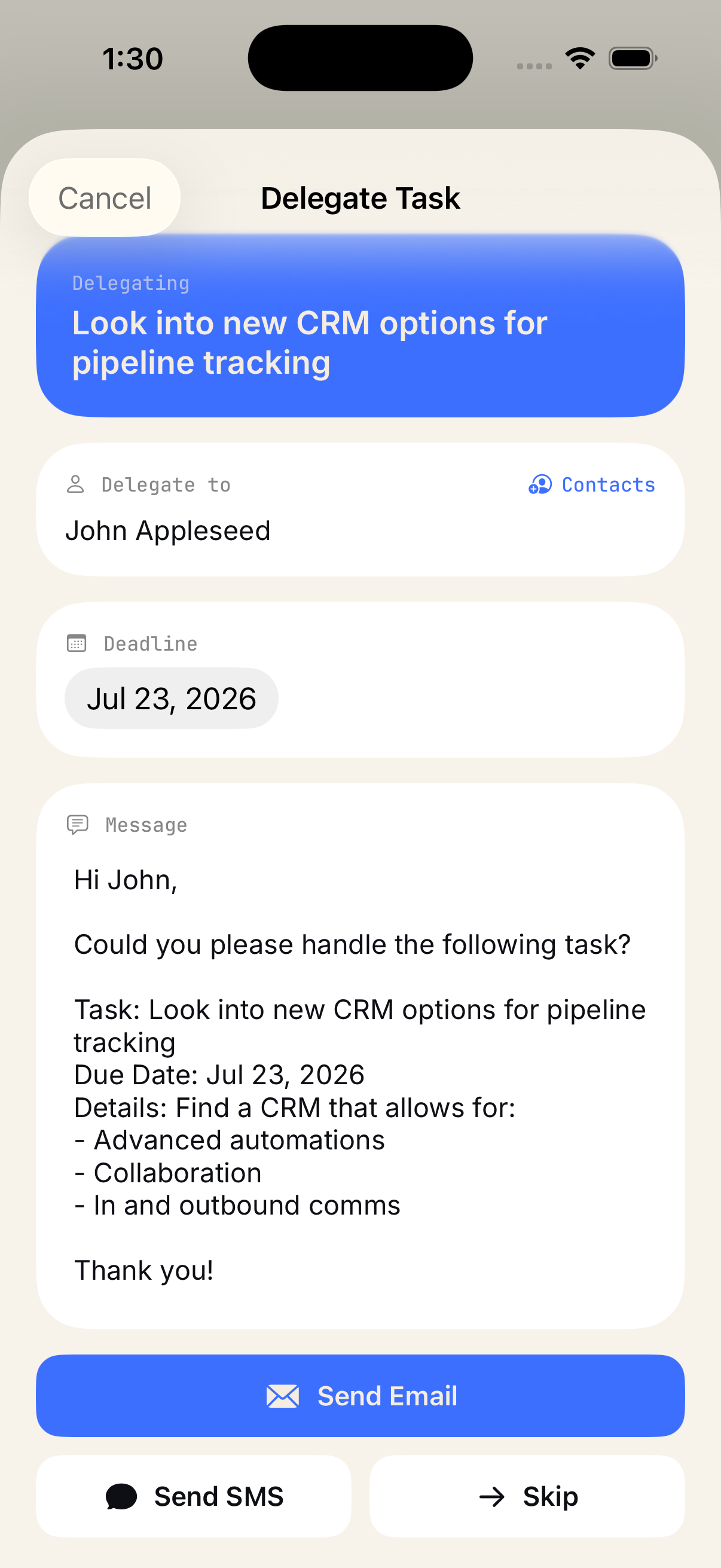
When you delegate, Loop can pull a person straight from your iOS Contacts and pre-fill an email or message — then it keeps the task on your Delegated list so you remember to follow up. (Your contacts never leave your device; Loop only uses them to fill in the composer.) When you defer, you snooze a task to a future date and it disappears from view until it's genuinely relevant — then it comes back, right on time, so you can act instead of merely worrying about it early.

Together they close the two most common leaks in personal productivity: the thing you're waiting on someone else for, and the thing that isn't ready yet. Out of your head, into a system you trust.

If it's not in the system, it's in your head — and that's the problem.

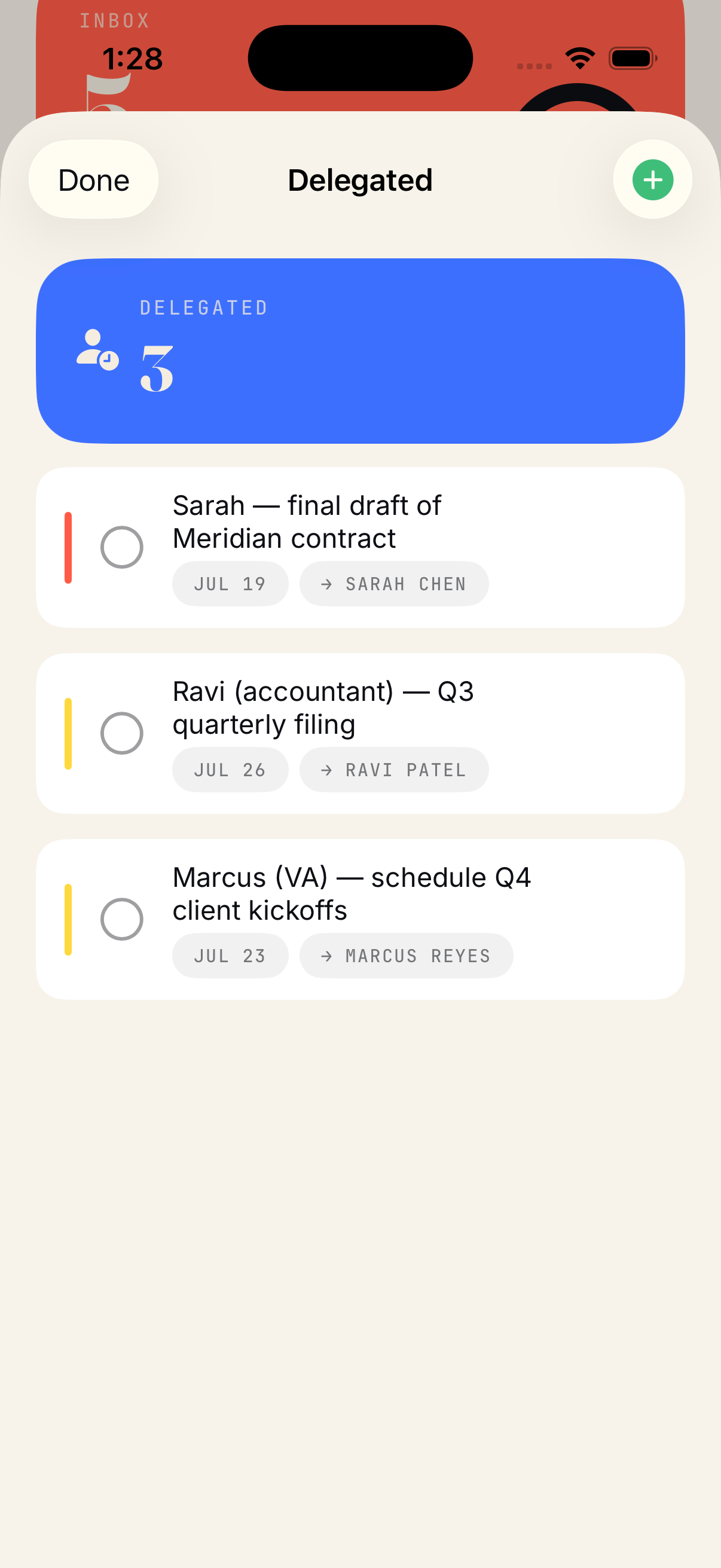
  1. 1 Delegated list Loop's Delegated list showing three tasks handed to named people with due dates.

    Everyone you're waiting on.

  2. 2 Hand it off Loop's Delegate Task sheet pre-filling an email to a contact, with Send Email and Send SMS options.

    Pre-filled from Contacts, one tap to send.

See it close your loops.

Loop is finishing App Store review. When it launches, this becomes your download link.

Coming Soon to the App Store